
Behind the Cold, Everything Still Echoes
How war, blackout, and distance teach the heart to freeze

After more than three months, I finally spoke with Sara.
I had imagined that hearing her voice would bring relief in a clean form, as if the soul were some orderly room and one could open a window and let the stale air out. But nothing in these days arrives clean. Relief came with trembling. With guilt. With the old animal fear that has been sitting inside my ribs since the bombing began. I heard her voice and felt something in me bend toward it, hungry and ashamed of its hunger.
She was alive.
That should have been enough for the moment. Perhaps for a better person it would have been enough. But love is greedy when it has been starved. It wants voice, then presence, then certainty, then the impossible comfort of knowing that tomorrow will not devour what today spared. I wanted to ask everything. I wanted to know whether she had slept, whether Tehran still had its shape, whether the streets smelled of dust or petrol or fear, whether her hope had survived the long darkness, whether her heart had gone somewhere I could not follow.
Mostly, I listened.
There are moments when listening becomes a kind of kneeling. Not before another person as an idol, but before the reality of their suffering. You stop arranging your cleverness. You stop polishing your insight. You let the other person bring what they can carry, even if it arrives broken, half-lit, badly wrapped, still smoking.
Sara spoke about the exhaustion. The fog. The way news, analysis, prediction, rumor, and dread had begun to move through her days like flies around a wound. She told me she had kept asking AI what would happen next. Again and again. What will happen next. What will happen next.
I understood immediately.
That question was not curiosity. It was an exhausted creature digging with its hands for a wall to lean against. It was the nervous system trying to bargain with catastrophe. If the next disaster could be named before it arrived, perhaps it would become less cruel. If the shape of the future could be forced out of a machine, perhaps the body would stop flinching at shadows. Perhaps the soul could say: there, I knew it, I was ready.
But war has no manners. It does not enter in sequence. It kicks open morning, afternoon, sleep, memory, appetite, language. It turns the future into a hallway where every door may hide a fire. Under such conditions the mind becomes almost childlike in its need for prophecy. Give me a sentence. Give me a map. Give me one little plank across the abyss. Even a false one, perhaps. Even that.
And then she spoke of her sister in Sweden.
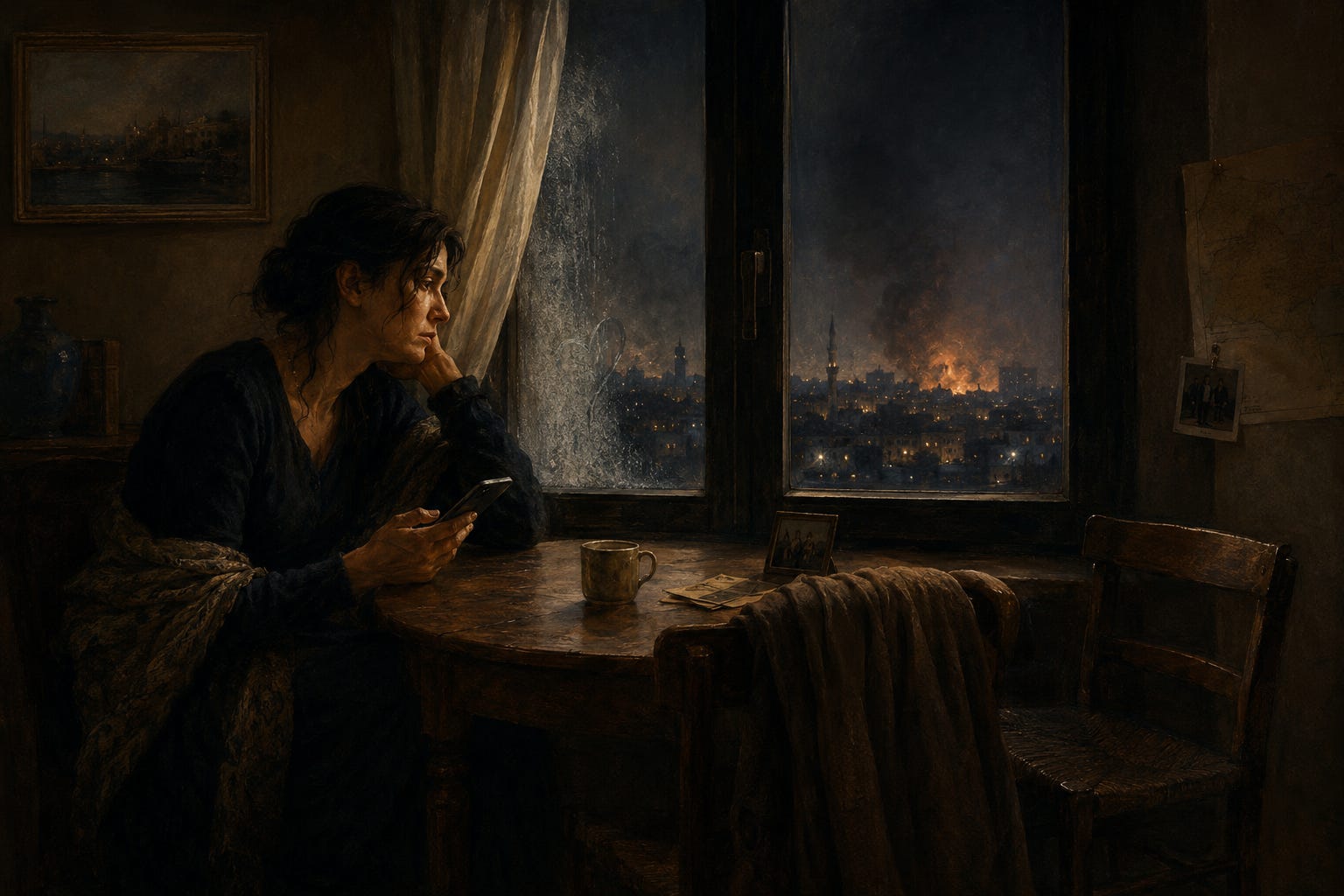
They are close. Very close. During the blackout, they could not reach each other. There is a pain in that which people who live in stable countries, with their full batteries and functioning apps and cheerful little notification sounds, may never understand. Missing someone under ordinary conditions is one sorrow. Missing someone when power itself has cut the thread between you becomes a darker thing. There is no ritual for it. No grave. No farewell. No proof. Only the hand reaching for the phone and finding a wall.
Sara said that at some point the missing became too much. Then something changed. She began to feel cold. As if perhaps it would not matter anymore. As if even two years without hearing from the people she loved might become bearable, or meaningless, or simply another fact among facts.
That frightened me because I knew exactly what she meant.
I have been in that cold room.
I know the strange mercy of it. The body, having failed to stop the pain, stops the feeling. It throws a white sheet over the burning furniture. It lowers the light. It says: enough, enough, enough. It says: if I continue to feel this, I will not survive the hour. It places ice around the wound and calls that ice peace.
And for a while, perhaps, it is peace. A counterfeit peace, yes, but who among the wounded has not lived from counterfeit bread when the real bread was gone?
I told her that her body was protecting her. I believe this. I believe it with the tenderness one feels for any poor creature that has chewed off part of itself to escape a trap. Numbness can be a form of intelligence. A brutal intelligence, but intelligence all the same. When the world becomes too much, the psyche builds a little cellar and hides what is most precious there.
Yet I also told her what I know from my own descents.
Behind that chill, everything echoes.
The love remains. The terror remains. The missing remains. The wound remains, waiting in its dark coat. Coldness can delay the encounter, and sometimes delay is mercy. But coldness cannot heal what it has covered. Stay there too long and the inner life becomes a sealed winter house. Nothing rots, perhaps. Nothing burns. The rooms remain arranged. The cups stay on the table. The photographs keep their faces. But no one lives there.
I could feel that truth as I said it to her. I could feel how easily I might have been speaking to myself.
Because I too know the desire to stop feeling. I know what it is to watch suffering grow so large that the heart begins to look for a legal loophole out of love. I know what it is to grow tired of caring, then ashamed of the tiredness, then angry at the shame. And beneath all of that, the old accusation: what kind of person becomes cold when others are still burning?
But that accusation has no wisdom in it. Only cruelty wearing a judge’s coat.
A person becomes cold because the fire has come too close.
A person becomes cold because love, trapped without action, begins to resemble torture.
A person becomes cold because the soul cannot keep standing at the window forever, watching for a figure that may never appear on the road.
There is no holiness in demanding constant heat from the human heart. The heart is flesh, after all. Poor flesh. Noble flesh sometimes, ridiculous flesh often, frightened flesh almost always. It beats and trembles and invents reasons and betrays itself and returns again, if given enough mercy.
What Sara showed me was the place where love, unable to move outward, had folded itself into silence to avoid tearing its own skin.
That is a terrible place. And a human one.
Since our call, I have been thinking about how many Iranians are living there now. Inside Iran. Outside Iran. In Tehran, in Stockholm, in The Hague, in Toronto, in Berlin, in all the borrowed cities where people learn to function while one half of their soul stands elsewhere without shelter. We wake in rooms where the lights work and the water runs and the calendar remains obedient. Then a message fails to arrive from home and the whole room tilts.
Exile does strange things to suffering. It does not remove it. It gives it a second address.
You go to work. You attend meetings. You answer emails. You say “yes, of course” while a darker sentence beats underneath: are they alive, are they alive, are they alive? You listen to colleagues speak of deadlines, train delays, office politics, holidays. You nod. You perform proportion. And somewhere inside you a child is standing barefoot in a bombed house, staring up through a broken ceiling at the indifferent sky.
Then people call this resilience.
I distrust that word more each year.
Real resilience does not always look like a mountain standing grandly against the storm. Sometimes it looks like taking medication to sleep. Sometimes it looks like snapping at your mother and hating yourself afterward. Sometimes it looks like working with clay until your body is too tired to harm anyone. Sometimes it looks like watching Harry Potter in Persian dubbing and crying for Snape because his loneliness has become safer to touch than your own.
Sara had done that too.
She had returned to an old story, hoping to comfort herself, and the story betrayed her by opening a door. She cried for Snape. Then she remembered the actor had died and cried again. Someone might smile at this from the outside, as people often smile when they have understood nothing. But grief is cunning. When the main road is blocked, it enters through the garden, covered in leaves, wearing the face of a fictional man who loved too long and too silently.
There is nothing childish in that.
When catastrophe becomes too vast to mourn directly, the soul chooses a smaller cup. A film. A song. A line of poetry. A childhood book. An old object held in the hand. Suddenly the cup overflows and we are astonished by the flood, as if the flood were new, as if it had not been waiting all along.
Flood and freeze. That is the movement I keep seeing. In her. In myself. In Iranians everywhere. We burn, then we harden. We cry, then we speak of logistics. We miss someone unbearably, then wake one morning unable to feel the missing. We ask what happens next, then stop wanting the answer. The nervous system moves like a hunted animal across ruined ground, sniffing for safety, mistrusting even tenderness.
I do not condemn this.
I cannot.
But I fear what happens when a whole people are forced to live too long inside that alternation. Fire, ice, fire, ice. Grief, numbness, grief, numbness. A nation can survive many things and still lose its tenderness by increments. Not in one grand betrayal. In tiny withdrawals. In the moment someone says, “I cannot care today,” and then tomorrow the same sentence returns, and later it becomes a worldview, and later still it becomes character.
That is how catastrophe continues after the bombs.
Iran has known too much of this. The Islamic Republic taught generations to divide the self, to swallow speech, to keep a second life hidden beneath the first. War adds its own hand to that old discipline. Bombardment from above. Repression from within. Internet blackouts. Families scattered and unreachable. Cities wounded. People learning once again that history can enter the kitchen without removing its boots.
A person cannot live under this without forming defenses.
A nation cannot either.
But defenses are treacherous things. The wall that saves you from the first assault may later keep out the very person who came to love you. The numbness that carries you through one season may ask, later, to govern the whole house. It begins as servant and dreams of becoming king.
This is why I wanted to speak gently to Sara’s coldness, but also truthfully. I did not want to drag her out of it. That would be another violence. I did not want to praise it either. That would be abandonment disguised as respect.
I wanted to stand near the door and say: I know why you are there. I know the room. Rest if you must. But do not build your altar there.
Healing, when it begins, will not arrive like a trumpet. It will not say grand things. It may begin with one ordinary sentence: I miss my sister. I wanted to call. I could not bear wanting. I froze.
That is enough. More than enough.
To speak the wound plainly is already to warm the air around it.
And perhaps this is what friendship must become in times like ours. Friendship becomes the person who remembers your warmth when you have lost access to it. The one who does not confuse your frozen face with your final truth. The one who can hear the echo beneath the cold and say: yes, something is still alive there.
Sara has been that person for me.
She has stood near my abyss without making a performance of courage. She has looked at sorrow without trying to make it polite. There are friendships that decorate a life, and there are friendships that reveal it. She belongs to the second kind. To hear her voice after three months was to recover a piece of my own language.
That is another cruelty of blackout. It steals not only information, not only convenience, not only the right to know whether someone is safe. It steals the witnesses who help us remain ourselves. It leaves each person alone with their own distorted mirror. Then, when contact returns, even briefly, one realizes how much of the self had been waiting at the broken line.
I do not know what will happen next in Iran. I have grown suspicious of anyone who speaks about the future with a clean mouth. Nothing is clean now. The future is being dragged through smoke by regimes, armies, markets, cowards, patriots, opportunists, mothers, prisoners, children, and ordinary people trying to buy bread while history sharpens its knives nearby.
There will be more pain.
I hate the sentence. I hate its authority. I hate that it sits there like an old creditor.
And still, I know another thing.
The cold is not the end of the story.
It is a room in the story. A hard room. A room where the soul hides from fire. A room one may need to enter in order to keep breathing. But it must not be mistaken for home. We cannot raise children there. We cannot build a country there. We cannot love one another from behind those walls forever.
At some point, when the body is ready, when the signal returns, when one true voice reaches another through the smoke, we begin again.
We say the names.
We admit the missing.
We let grief return in portions small enough to survive.
We speak to the wound like one speaks to a frightened child hiding under the table after the house has shaken: come out slowly, no one will force you, but come out. The world is terrible, yes. The world is also waiting for your face.
Behind the cold, everything still echoes.
The echo means love has not left.
It is waiting
for warmth to find us again.
"The world is terrible, yes. The world is also waiting for your face." This essay of yours is a strong manifesto, Elham. and it leaves no room for band-aids or false optimism. It's powerful in its nakedness and leaves the readers few options but bearing witness. Therefore, here I am. With love, Maria
A tragic, heartrending story, so eloquently written. You convey so many images and feelings from your experience and perceptions, which are difficult for those who haven't experienced them to comprehend. I admire how you are able to express your feelings so powerfully.